
The Ambulance Service have had a difficult time over the last two years, but remain one of our most treasured institutions. But what about its history? How did Ripley people cope before the days of flashing blue lights?
Ambulance carriages were first widely used in the Crimean War; by the 1880s, many of the local collieries had their own specially adapted horse-drawn cart like the one shown here: accidents were frequent occurrences in the pits. The St John Ambulance Brigade was formed in 1887 and in 1891 the local Brigade was presented by the mine owner Charles Ford with an ambulance carriage, designed and constructed by Holmes of Derby. By this time the Butterley Company also had their own vehicle.
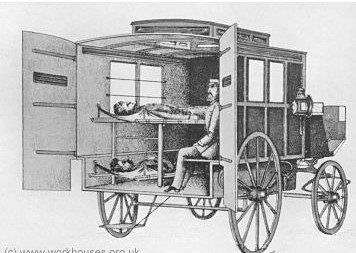
When Tom Neal, an injured miner, was taken in such a carriage to Derby hospital in 1910, he lost so much blood on the way that he later died, and his death spurred on the building of Ripley hospital, which opened in 1912.
During World War 1, motor ambulances were widely used, and in 1921, the Denby Drury-Lowe Company claimed to be the first in the area to possess one. Butterley soon followed, but Ripley itself still relied on a horse-drawn vehicle. It wasn’t until 1937 that the council took delivery of a Bedford two-stretcher motor ambulance, costing £356. It would have looked something like this London model.
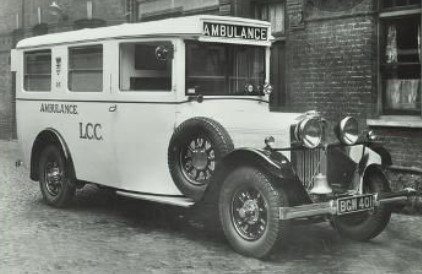
This one vehicle, supplemented by those of the Pentrich Colliery and Butterley works, (and a borrowed one during the war) provided the service until 1948 when, with the establishment of the NHS, the ambulance service was created as a separate county-wide body. In 1955 Ripley’s ambulance station opened in Ivy Grove.
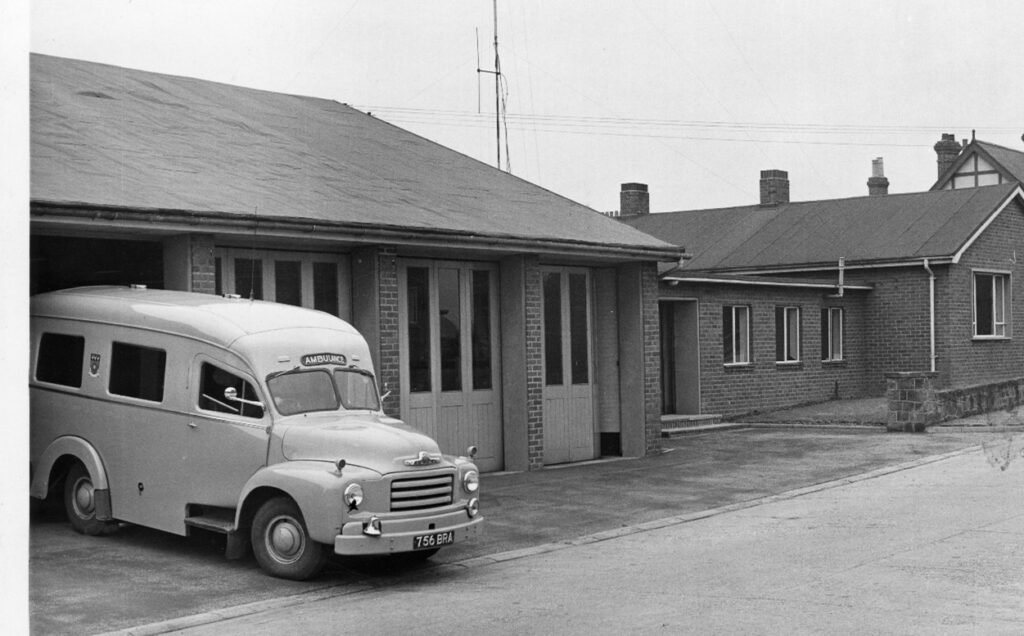
And flashing blue lights weren’t officially fitted to ambulances until 1989.