
The Pure Order of United Britons was a friendly society, formed around 1864, with branches across the East Midlands and several outposts in South and West Yorkshire and the West Midlands. Its Ripley Branch, the ‘Do Well Lodge’ was particularly strong and survived until 1949, a year after the foundation of the National Health Service.
Friendly Societies were hugely important organisations in the days before state welfare provision as they insured workers against times of hardship, with payments made for sickness, unemployment and funeral expenses. Millions of people joined societies in the industrial era, and with their rule books, committees and formal meetings, they offered opportunities for workers to gain experience of running democratic organisations and develop skills which would enable them to become active in politics or other aspects of public life.
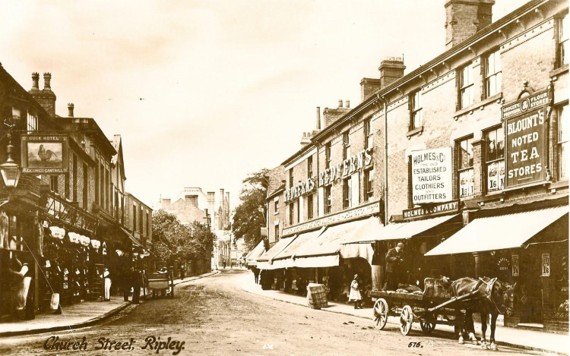
Church Street and the Cock Hotel, Ripley
An offshoot of the Oddfellows, the Pure Order of United Britons (POUB), like other friendly societies, invoked a mythical past with its name suggesting an ancient lineage, and its rule book, rituals and regalia reinforced its ‘heritage’ and lent it a moral legitimacy. This helped the Order to be seen as trustworthy by both its members and the outside world. Respectability was essential, particularly in the Victorian period, and societies such as the POUB were keen to be seen to uphold the morals and standards prevalent at the time.
Sociability was an important part of the life of the friendly societies, with meetings in the public house, as well as feast days, galas and processions. Although heavy drinking was discouraged, conviviality, singing and pleasurable discourse were all part of society life, helping to engender a sense of belonging and cement the bonds of membership. In 1897, an ‘excellent repast’ was enjoyed at the Cock Hotel, Ripley by 70 members, a singer entertained the audience with ‘exceptional taste’ and toasts were made to the surgeon and to ‘the Butterley Company (whose employees probably made up a large proportion of local members) and other employers of labour’.
In July 1900, the Ripley United Friendly Societies Gala and Demonstration was held on a field near the station on Nottingham Road, and crowds were entertained by the Besses-o’-the-Barn Brass Band and the Church Lads Fife and Drum Brigade. The POUB was joined by the Loyal Order of Ancient Shepherds, the Ancient Order of Foresters and Derby Midland Order of Oddfellows as they processed to the gala. After the bands, entertainment continued with a troupe of gymnasts and ring-walkers, knife and tomahawk throwers, and a horizontal bar act. Refreshments were provided by the White Lion Hotel, Ripley and a ‘unique firework display’ which according to the Ripley and Heanor News, was ‘probably better than any previously given in the surrounding district’.
The pleasurable aspects of membership were balanced by a fairly rigid set of rules, with punitive measures imposed for transgressions. For example, members guilty of blaspheming or insulting a fellow member were fined one shilling; members sleeping, laying wagers, or reading books or papers not relating to lodge business at any meeting, were to be fined threepence, and members disobeying the presiding officers fined a shilling. Those in receipt of sickness allowance were not allowed out of the house at night after 8pm in summer and 6pm in winter, and were prevented from visiting the pub without permission from the surgeon (GP) or the Lodge.
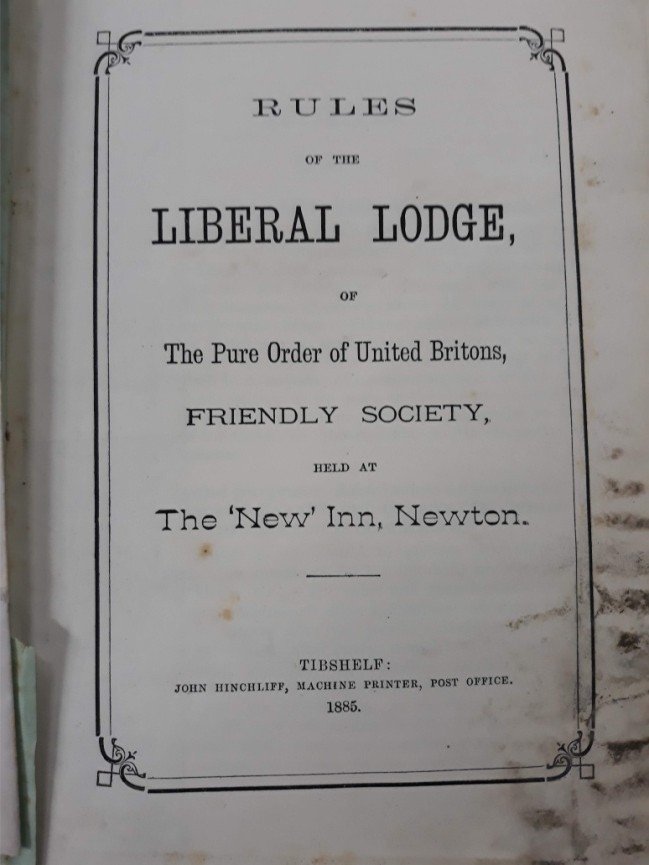
Cover of the sole surviving POUB rule book, from Newton, Derbyshire (Courtesy The National Archives)
The Annual Moveable Committee (AMC) was the equivalent of the AGM, when all lodges came together to discuss finances and policy. The 1893 AMC was held at the Cock Hotel, where 48 lodges were represented and the health of the Order celebrated, with £2500 in the funeral fund, and 2450 members in the Derbyshire area. By the start of the First World War, the Order had started to decline, but Ripley and surrounding area defied the trend and became a stronghold, with its Ripley and Waingroves Lodges accounting for 390 members out of a total membership of 1318. At its 1917 AMC, again held at the Cock Hotel, Order Secretary Thomas Leaman read out the names of those members who had perished in the war, confirming that all death claims had been honoured : ‘Thousands of young lives had been sacrificed, of which our small Order had been called upon to bear its share’.
At its half-yearly meeting in July 1923, the Do Well Lodge was still in robust health. The meeting, at its usual venue the Cock, heard that the lodge was in a ‘flourishing condition’ with between 300 and 400 members, and with 14 new members proposed. That the Ripley lodge continued to function through the 1930’s and into the 1940’s is testament to how highly its services were valued, as well as to the selfless efforts of its volunteer officials who kept it going for over 80 years.
Wherever money is involved, there is always the potential for criminal activity, and the POUB was not immune to fraudulent activity. John Kew, a shoemaker from Marlpool was sentenced to six months imprisonment with hard labour in November 1885 following his conviction for stealing £65 6s from the trustees of the Marlpool Peace and Goodwill Lodge of the POUB. Perhaps because the societies were totally reliant on volunteers, they were also vulnerable to those who were untrustworthy.
The Pure Order of United Britons was a good example of working class voluntarism and collective self-help in the days before national insurance, the health service and welfare state. Friendly societies, through the sociability provided by membership, offered an escape from workers’ mundane lives of labour, and gave them protection from lost income through ill health and accidents at work.
Phil Henshaw, September 2020