
Until the 1920s, divorce was rare; it was unheard of before the mid-19th century when an Act of Parliament was required. There were, however, steps that could be taken by ordinary people when a marriage broke down.
In 1760 a notice appeared in the Derby Mercury from one Thomas Brightmore of Ripley. He declared that his wife Mary “hath lately elop’d from her husband” and urged anyone who read the notice not to trust her, as he would not pay any debts she contracted; anyone harbouring her would be prosecuted.

This was not so unusual: other such notices did appear – later that year, for example, William Shore of Higham published a similar, if slightly more forgiving, piece.
What was unusual was that, according to parish records, Thomas Brightmore at the age of 40 had married Mary Calladine, half his age, only 18 months before. What’s more, he was a labourer, and couldn’t read or write.

So how did the notice appear? He must have walked to Derby, made his way to the shop of Samuel Drewry, the Mercury’s publisher, in Irongate, explained what he wanted, paid, and left Drewry to write, typeset and publish.
What determination, what sheer bloody-mindedness!
It appears from the records that Mary died two years later and four years after that, Thomas is found applying for a licence to remarry to Sarah Beresford, a widow. Again, it is unusual to find a man with no education or property applying for a licence, but it may be that the vicar insisted upon it.
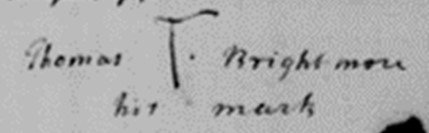
He had to declare that he knew of no “lawful let or impediment” why he should not remarry. He signed with a T – “Thomas Brightmore, his mark”.
He died two years later in 1768.